by Priyanwada Atapattu
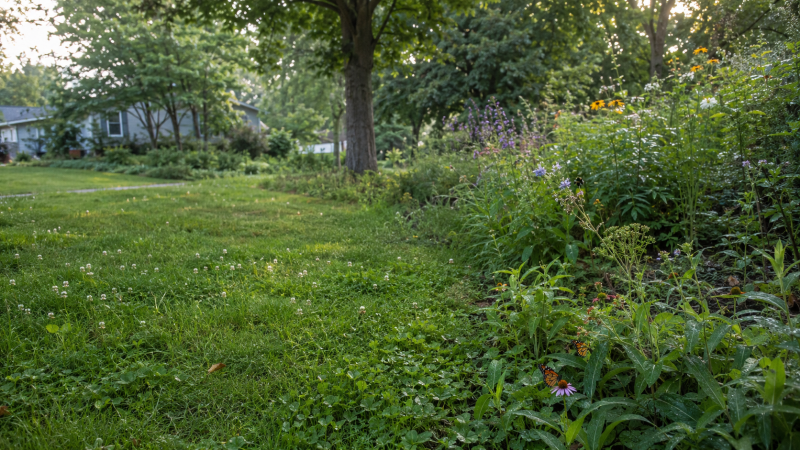
Lawns are among the most widespread human-managed ecosystems in residential and urban landscapes. They occur around homes, schools, businesses, parks, roads, and public institutions. Although lawns are often viewed simply as decorative green spaces, they influence biodiversity, soil processes, water movement, carbon cycling, local temperatures, and human interactions with nature.
The modern lawn developed from European traditions that valued short, uniform grass as a symbol of wealth, order, and control over the landscape. Today, lawns provide important recreational and social spaces, but intensive lawn management can consume water and energy, reduce habitat diversity, and introduce fertilizers and pesticides into surrounding ecosystems.
Understanding lawn ecology therefore requires a balanced approach. Lawns are not ecologically beneficial or harmful in every situation. Their environmental effects depend on where they are located, which plant species they contain, how intensively they are managed, and what type of habitat they replace.
Lawns as Human-Managed Ecosystems
A lawn is not simply an empty space covered with grass. It is an ecosystem containing plants, fungi, bacteria, soil animals, insects, and other organisms interacting with water, nutrients, soil, climate, and human management. Unlike naturally occurring grasslands, conventional lawns are maintained in an early and simplified stage of vegetation development. Regular mowing prevents grasses and other plants from growing tall, flowering extensively, or developing into more structurally complex vegetation. Weed removal, fertilization, irrigation, and pesticide use further shape the lawn community. As a result, the structure and ecological functions of a lawn are strongly controlled by people. Mowing height, mowing frequency, grass selection, fertilizer use, irrigation, leaf removal, and tolerance for flowering plants can all affect the ecological value of a lawn.
Lawns and Urban Biodiversity
Conventional lawns generally contain fewer plant species and less structural diversity than forests, shrublands, native meadows, or mixed gardens. Many lawns are dominated by a small number of turfgrass species selected for their ability to tolerate mowing and foot traffic. This simplified vegetation provides relatively limited habitat for wildlife. Closely mown grass offers few flowering resources for pollinators and little vertical structure for insects, birds, and small animals. The removal of leaf litter, fallen branches, seed heads, and flowering plants further reduces food and shelter.
However, lawn biodiversity varies considerably. A lawn containing clover, violets, dandelions, and other low-growing plants may support more insects than a chemically maintained turf monoculture. Less-frequently mown areas can allow plants to flower and provide nectar and pollen. The ecological effect of a lawn also depends on what it replaces. Converting a forest, wetland, or native meadow into lawn usually causes substantial habitat loss. In contrast, replacing pavement or bare compacted soil with vegetated ground cover may produce ecological benefits.
Ecological Homogenization
The global spread of lawns has contributed to ecological homogenization; the process through which landscapes in different regions become increasingly similar. Residential lawns are often planted with the same small group of commercially available grasses, even across areas with very different climates, soils, and native vegetation. Similar mowing, irrigation, fertilization, and weed-control practices further standardize these ecosystems. This uniformity can reduce regional ecological identity. Local plant communities adapted to specific environmental conditions are replaced by similar turfgrass landscapes. Ecological homogenization may also favor widespread generalist species while reducing habitat for organisms dependent on native plants. Using regionally adapted grasses and incorporating native plants can help restore ecological differences among landscapes.
Effects of Mowing on Lawn Ecology
Mowing is one of the strongest ecological disturbances affecting lawns. It removes plant tissue, prevents many species from flowering, reduces vegetation height, and changes competition among plants. Frequent mowing favors low-growing plants that can survive repeated cutting. Taller plants and species that require time to produce flowers and seeds are often eliminated. As a result of that, mowing can reduce plant diversity when it is too frequent or combined with herbicide use. Mowing also affects insects and other invertebrates. Cutting vegetation can directly injure organisms, remove food resources, and reduce shelter. Very short lawns are generally hotter and drier near the soil surface than taller vegetation, creating less favorable conditions for some soil and surface-dwelling organisms. Reducing mowing frequency can allow more flowering and increase habitat complexity. This does not require abandoning lawns completely. Frequently used areas can remain short, while lawn margins and low-traffic zones can be cut less often.
Lawns, Pollinators, and Food Webs
Pollinators need a continuous supply of nectar and pollen throughout the growing season. Uniform grass lawns generally provide few of these resources because turfgrasses are wind- pollinated and mowing prevents many flowering plants from blooming. Allowing selected low growing flowers to remain can improve the food value of lawns. However, flowering lawns should not be treated with insecticides that could expose visiting pollinators to harmful chemicals.
Ecological benefits can extend beyond pollinators. Plant diversity supports herbivorous insects, which in turn provide food for birds, spiders, and predatory insects. Lawns containing native plants along their edges are more likely to contribute to functional urban food webs than lawns isolated from other vegetation. Even so, a flowering lawn does not usually provide the same habitat complexity as a native meadow, shrub layer, or woodland. It is best understood as one component of a larger connected landscape.
The Future of Lawns
The future of lawns does not necessarily require their complete removal, but rather a shift from large, uniform, intensively managed turf areas toward smaller and more ecologically functional green spaces. Lawns will continue to provide valuable areas for recreation, social interaction, and public use, particularly in urban environments. However, reducing mowing frequency, limiting fertilizer and pesticide use, conserving water, allowing low-growing flowering plants, and integrating lawns with native flowers, shrubs, and trees can substantially improve their ecological value. Such landscape mosaics can provide resources for pollinators, strengthen urban food webs, improve soil health, regulate temperature, and manage stormwater while retaining the practical benefits of open grassy spaces. Therefore, the modern lawn should no longer be viewed simply as a perfectly maintained green surface, but as a flexible component of a diverse and resilient urban ecosystem.
Add comment
Comments